2025 and the Rise of 'AI Slop': Is the Internet Ready to Mature?
2025 and the Rise of 'AI Slop': Is the Internet Ready to Mature?
Discover how the phenomenon of 'AI slop' has transformed the quality of digital content and what this means for our future online.
"It's not about finding answers, but about learning to ask better questions." – Rilke
Imagine one day you open your browser, and instead of finding what you are truly searching for, you are faced with a sea of irrelevant, low-quality content. That was 2025 for many of us, a year where the term 'AI slop' became part of our everyday vocabulary, reflecting the saturation of AI-generated content.
Suddenly, your news feed is filled with absurd memes, articles lacking depth, and shopping platforms cluttered with misleading descriptions. In this new scenario, how does this affect our perception and behavior? This is the story of Eva, a young woman who, like many, began to experience the chaos of 'AI slop' in her daily life.
Eva, a reading enthusiast, always sought articles that would help her refine her career. One afternoon, frustrated by the lack of useful information, she decided to share her experience on social media. “Why is it so difficult to find quality content?” she asked. Instantly, her post was flooded with responses. Many felt the same: they were overwhelmed by the amount of information that led nowhere. This interaction revealed a broader phenomenon, a feeling of collective disillusionment.
The Invasion of 'AI Slop'
'AI slop' is characterized by its mass production of content that lacks authenticity and relevance. But what does this really mean? In 2025, it was estimated that more than 60% of the content available on the web was created by artificial intelligence with little or no human oversight. This raises inevitable questions about the quality and value of the information we consume and share daily.
From a critical standpoint, many voices are raised to warn about the dangers of this type of content. The saturation of irrelevant material not only compromises our online experience but also affects our way of interacting with the world. Meanwhile, from a technical perspective, discussions continue regarding the inherent limitations of these AI tools that produce this content, making it clear that a machine, no matter how advanced, can never capture the essence of the human experience.
Digital Interactions: The Social Impact
As 'AI slop' became more common, the way users interacted on digital platforms also began to change. Fraudulent and misleading content eroded trust and the sense of community. Many users began to feel increasingly disconnected and frustrated. “Why spend my time reading something that offers no value?” they wondered. This emotional state of disillusionment has generated a kind of apathy towards platforms that were once seen as reliable sources of information.
However, not all is lost. This collective suffering invites us to reflect on what we really want from the content we consume and how we can choose more consciously. Can we regain control over what we read and share? This is a challenge that involves not just us as consumers, but also the businesses and governments that must establish more effective regulations.
Economic and Philosophical Reflections
From an economic perspective, 'AI slop' has profound implications. While it may seem attractive for businesses in terms of cost, by resorting to low-quality content, we are sacrificing customer loyalty and the credibility of our brands in the long run. Companies that realized this began to prioritize quality over quantity, making it clear that, at the end of the day, genuine value will always outweigh rapid and massive production.
Philosophically, the concept of authenticity becomes an invaluable asset. In a world where information is produced at an overwhelming pace, the quest for meaningful content becomes more critical than ever. How can we, as a society, value what truly matters and avoid getting lost in the fog of digital mediocrity?
Towards a Better Future
While we have reached a critical point, there is also hope. The possibility of improving the quality of AI-generated content and its positive integration into society offers us a light at the end of the tunnel. It's about working together to develop tools that foster creativity and authenticity, helping people rather than replacing them. AI tools can be allies in our journey towards more relevant and meaningful content.
Businesses and governments must collaborate to establish regulatory frameworks that ensure AI is used ethically and productively. By doing so, we can avoid falling into a trap of empty content and ensure that technology serves human creativity and not the other way around.
Reflecting on Change
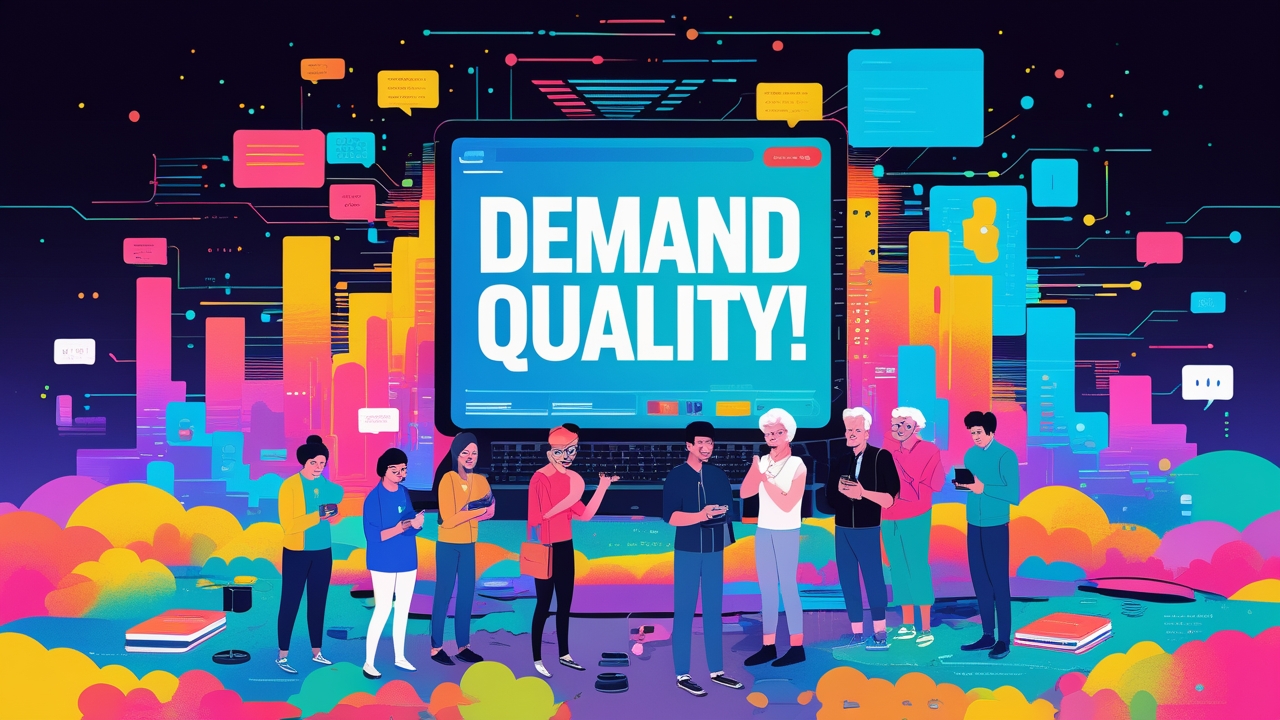
Looking back at Eva's story, we can question: what if the community united to demand quality content? Imagine a future where our digital interactions are based on authenticity, where every piece of information we consume nourishes our curiosity and creativity.
On this journey, it's essential to remember that we are not alone. The fight for quality content is a collective effort, and each of us has a role to play. Perhaps sharing an experience or asking a question can be the first step towards restoring value in our digital platforms.
Call to Action
Thinking critically and choosing content consciously is a first step, but it’s also time for all of us to be agents of change. I invite you to explore new platforms that promote quality content, collaborate on initiatives that seek to elevate the conversation, and share your findings with your community. Together, we can contribute to a positive transformation and make 'AI slop' a thing of the past.
Book some metoring time with Tuyo Isaza: Book your discovery session. AI slop, contenido de calidad, inteligencia artificial, experiencia en línea, transformación digital
Please visit for more articles: www.tuyoisaza.com
AI slop


Comentarios