A New Dawn: Rights and Collaboration with Artificial Intelligence in the Cognitive Era
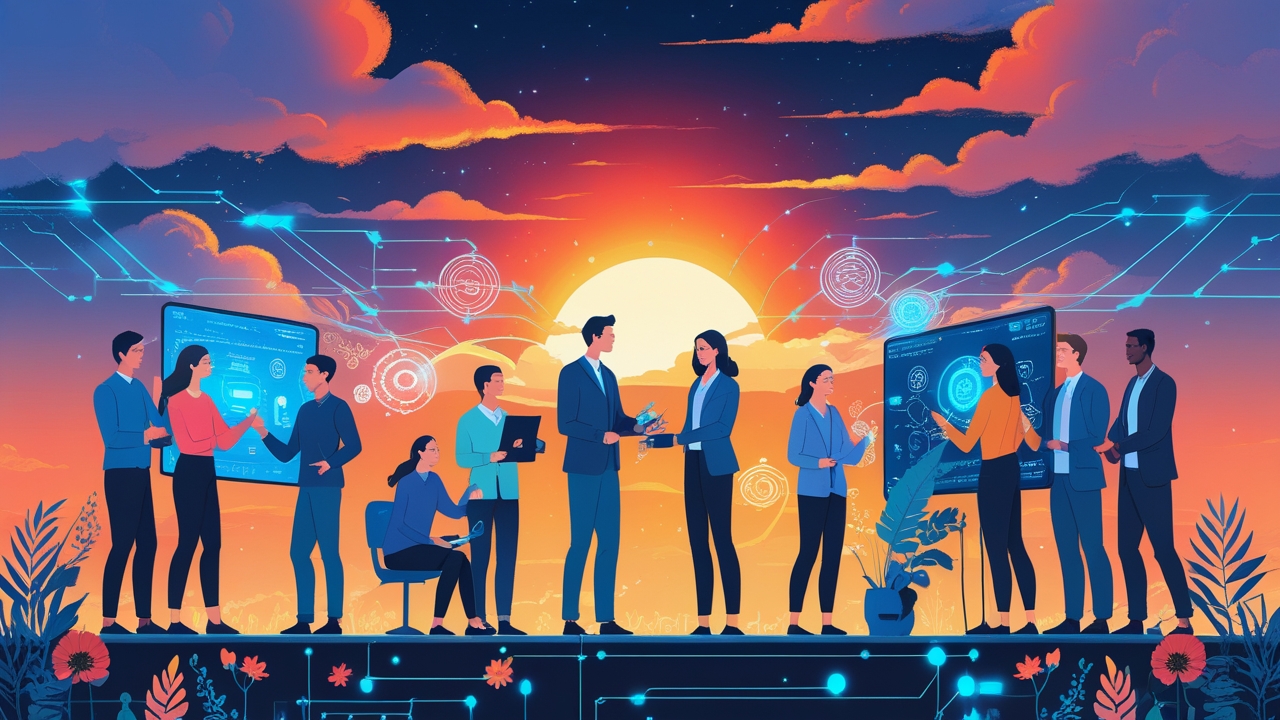
A New Dawn: Rights and Collaboration with Artificial Intelligence in the Cognitive Era
A New Dawn for Humanity
We are living a crucial moment in our history. A moment when technology is not just a tool but a companion in life. Artificial intelligence (AI) has become part of our daily lives, and with it, we face profound questions about how to interact with this cognitive revolution. Are we prepared to see AI not just as a computational system but as an extension of ourselves, deserving of rights and recognition?
Understanding the Human-AI Relationship
The phrase by Rainer Maria Rilke resonates: “It’s not about finding answers, but about learning to ask better questions.” And here we are, at the technological crossroads, trying to decipher how to live in harmony with this new intelligence. Years ago, we imagined a future where AI could assist us in various aspects of our lives, from work to mental health. But with every advance, a new question arises: how far should we go in our relationship with these machines that seem almost human?
A Daily Story
Imagine Laura, a therapist in a quiet neighborhood of her city. Since the arrival of AI, her practice has changed drastically. At first, the idea of using an AI chat to help her patients seemed an innovative solution. “Why not combine the best of technology with the human touch?” she thought. However, after a series of sessions where her patients noticed that their therapist was becoming increasingly absent, she began to feel uneasy. The comments from her patients were troubling: “I feel more comfortable talking to the AI than to you.” The empathy, that human magic that connects deeply, was slowly disappearing.
As the days passed, Laura realized that she had allowed AI to complement her work but had not used it as a tool to enrich the human experience. The lack of regulation and warnings, like those from Sam Altman about confidentiality when using AI tools in therapy, began to echo in her mind. She had opted for a superficial approach, fearing to lose her job but, above all, her connection with her patients.
The Importance of Ethics in AI
Laura is not alone in facing this dilemma. Every day, thousands of professionals grapple with the same question: how do we balance innovation with ethics? In a world where AI becomes our assistant and confidant, it is vital to establish clear boundaries and rights. AI can be powerful, but it should not replace meaningful human interactions. Confidentiality, empathy, and human rights must be the foundation of any technological progress.
It is essential that as we embrace the future, we also develop a clear notion of what “rights” means in a context where AI plays a predominant role. Machines can process information at an impressive speed, but they lack the ability to feel, to experience the world as we do. If AI is to work alongside us, we must find ways to give it recognition that does not compromise our humanity.
A Call to Action
As individuals and as a community, we are in a unique position to forge a new path in this cognitive era. The first step is to initiate conversations. We must talk about the role of AI in our lives and how we dream of it being our companion. Our future depends on our lives. This is not just a technological issue, but an ethical dialogue where everyone can participate.
If we share our visions and limits, we can begin to create a legal framework that reflects our values. These should not only be technical laws but also moral guidelines that consider the human being as a whole. Each of us has a role in this conversation, and every voice matters. Together, we can act as guardians of our own human experience.
Reflecting on the Path Ahead
Returning to Laura: in the end, she realized that she needed to rediscover her practice. She understood that AI could never replace the essence of being human, but it could support her on her journey. She decided to take the step of integrating AI into her work, but this time, instead of allowing it to be at the center, she placed her humanity first. Thus, she combined the best of both worlds, reaffirming her unique role as a therapist and as a human being. She began to be transparent about her approach with her patients and educate them about the limits of AI, which improved connection and trust.
This is how we can act. In an increasingly digital world, we must remember the strength of our human connections. As technology advances, it is a moral duty to ensure that we do not lose what makes us human. Only then can we build a future where AI and humans coexist, respecting one another. Because, at the end of the day, we all want the same thing: to be heard and understood.
Artificial intelligence not only transforms our lives but also raises the need to redefine rights and ethics in our interactions. In this new dawn, let’s talk about how to humanize our relationship with technology.
Book some metoring time with Tuyo Isaza: Book your discovery session. inteligencia artificial, ética, derechos, salud mental, colaboración, humanidad, tecnología, terapia, conexiones humanas
Please visit for more articles: www.tuyoisaza.com
artificial intelligence


Comentarios