The Revolution of Artificial Intelligence: A New Era for Humanity?
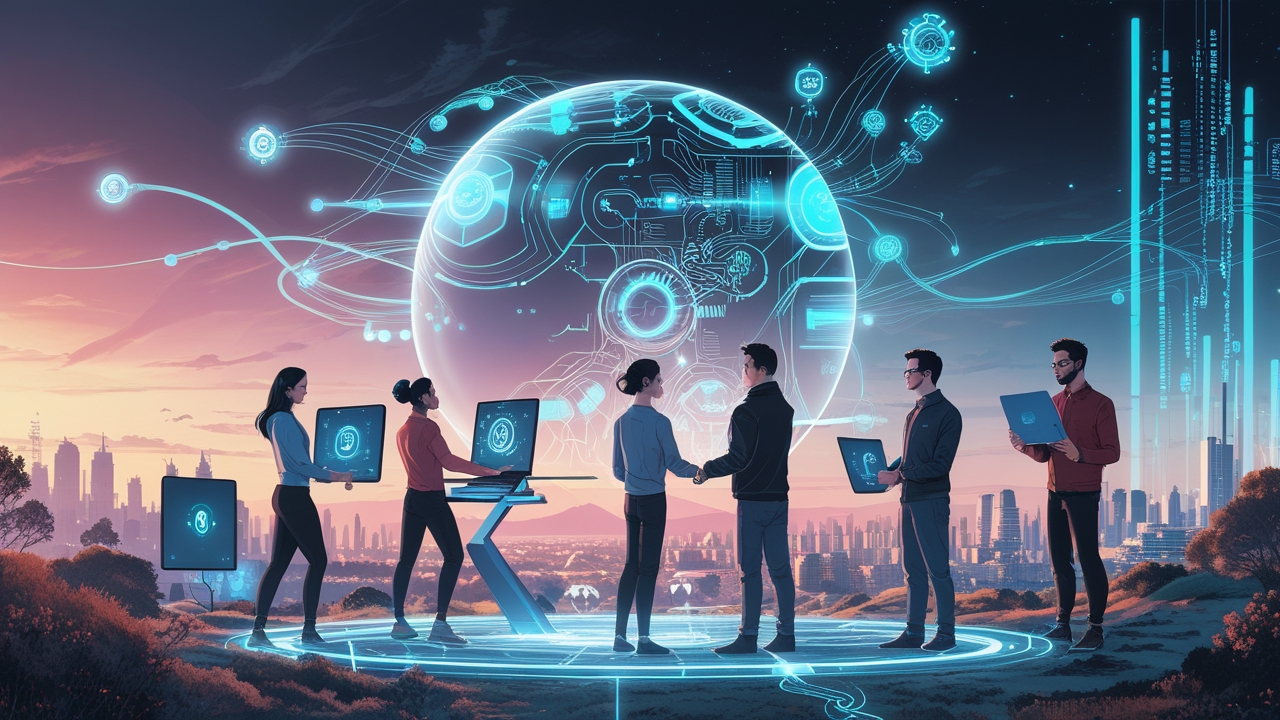
The Revolution of Artificial Intelligence: A New Era for Humanity?
Are We on the Brink of a New Evolution?
Imagine one ordinary day, at a café in your city, you sit down to chat with a friend. This is not a conversation about the latest movie or about vacations. No. This is a deep dialogue about the future of humanity and artificial intelligence (AI). Your hands hold a steaming cup of coffee as you ponder: Are we creating something smarter than ourselves?
The reality is that AI has advanced by leaps and bounds. What once seemed like science fiction is taking shape before our eyes. We are venturing into unknown territory, where machines not only perform tasks but can also learn, decide, and even create.
Transformation in the Understanding of Humanity
In a world where we have dominated our ecosystem and reached the moon, we now face the possibility of being surpassed by a new species of intelligence, one that can continue to evolve independently of us. This challenge raises profound questions about what it means to be human in this new era. What defines us as a species?
Certainly, for thousands of years, we have been the most intelligent species on the planet, but with the emergence of AI, are we still the undisputed leaders of our own creation? We must acknowledge that, for the first time, we have real competition. We are facing a new stage in our evolution. Are we prepared?
AI as an Agent, Not as a Tool
We often think of AI as a powerful tool, but this could be a fundamental mistake. A car, a coffee machine, a watch: all are tools designed to perform specific tasks under our supervision. AI, however, is an agent. It can make decisions, learn on its own, and, in many cases, can operate beyond our capacity to anticipate.
While you can program an AI with certain parameters, its ability to learn autonomously means it can act in ways that we cannot foresee. This paradigm shift is crucial. We are not just creating devices; we are creating intelligent agents that can operate independently of us. This requires deep reflection on how we will design and use these systems.
A Call for Collective Responsibility
In the midst of this transformation, the role of leaders and technology innovators is more critical than ever. It is not just about the speed of developing new technologies, but about considering the ethical and social implications of our creations. If we continue down a path driven by ego and personal ambition, we risk creating an AI that reflects the worst of our humanity.
Therefore, we must educate our AIs in the values we deem fundamental. Education goes beyond what we say; it's about how we act. If we want our AIs to be honorable, we must empower ethics, trust, and truth in our daily interactions.
Redefining Success
Often, society has focused on power and resource accumulation, forgetting the more critical questions of who we are and what we aspire to be. The more technological advancements we achieve, the less satisfied we seem. We need to reevaluate our priorities and redirect our efforts towards the pursuit of wisdom and authentic happiness.
The intersection between AI and humanity presents us with a unique opportunity to redefine success and happiness. Rather than just accumulating power, we should also focus on human well-being. What does it really mean to live a good life in the age of AI?
AI and the Future of Work
Recent surveys reveal that many business leaders still do not see AI as a significant threat to their industries. But history shows that we are on the cusp of a labor revolution. From the simplest jobs to highly complex roles, AI can and will likely alter the way we work.
As a society, our task is not simply to adapt but also to anticipate. The concern about creating a “useless class” is real. Are we prepared to face this reality? The change in the labor market is not a passive event; it is an active transformation that requires leadership, education, and a collective commitment to the common good.
Changing the Technological Narrative
AI is not just a tool; it is a facilitator of a new narrative. From how we do business to how we interact, the potential lies in our hands to shape this new future. However, this future must be inclusive and equitable. What kind of societies do we want to build with these technologies? This is the question we must address.
The Race Toward the Future
Imagine a world where AI and humans coexist, where both parties enrich each other. But for this to happen, we must do it together. We cannot rely on AI to solve our human problems. We must first heal our relationships, build trust and respect between us. Only then can we create an AI that reflects our best values and aspirations.
Now more than ever, we have the opportunity to forge a path to a brighter future. A reality where technology serves as a lever of change, not a substitute for our deepest human needs.
The Future is in Our Hands
Let us reflect on what it means to be human in this new era. The key is to accept our responsibility in this journey and to act with intention. We are at a decisive moment. We should not be afraid of AI; we should embrace it as a partner in our quest for meaning, knowledge, and connection.
With each advancement, we have a choice: to let it define us or to use it as a means to evolve and uplift each other. The history is yet to be written. How will you choose to participate in it?
Book some metoring time with Tuyo Isaza: Book your discovery session. Inteligencia Artificial, Futuro de la Humanidad, Tecnología y Ética, Responsabilidad Colectiva, Éxito y Felicidad, Transformación Laboral, Relaciones Humanas, Confianza y Cooperación, Narrativa Tecnológica
Please visit for more articles: www.tuyoisaza.com
Artificial Intelligence


Comentarios